

Malaysian Universities Are Rising in Global Rankings — But What Does That Mean for Job Prospects?
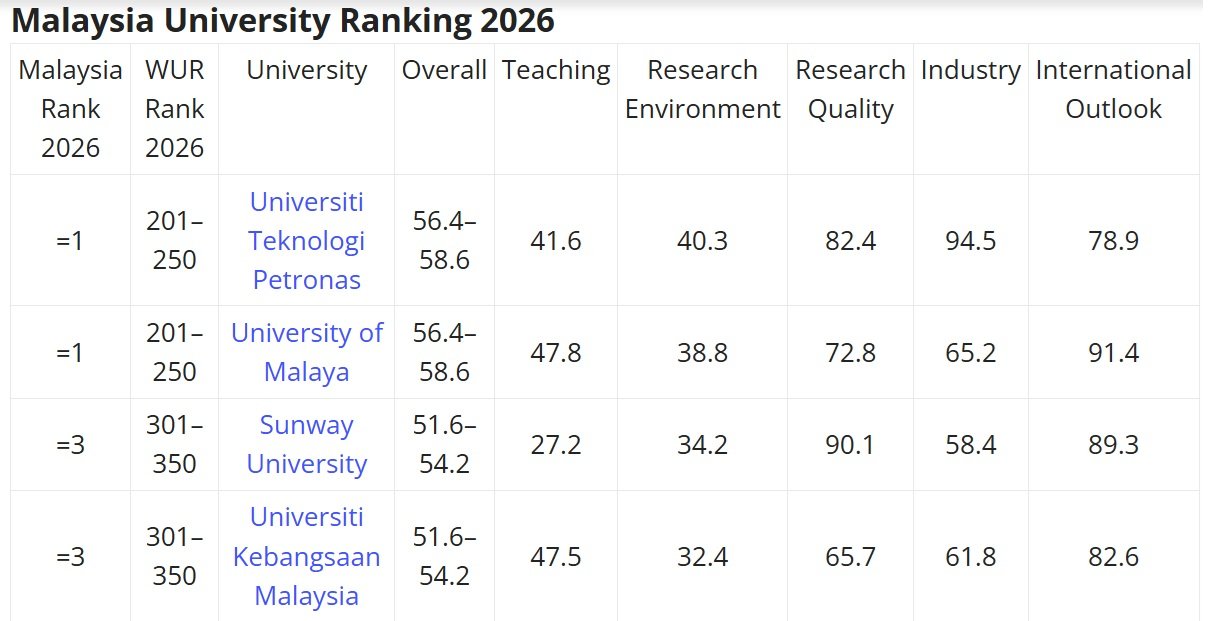
Extracted from Times Higher Education
Over the past few years, Malaysian universities have shown visible improvement in international rankings, reflecting stronger research output, better international visibility, and growing academic competitiveness. But for students and parents, the more important question is this:
1) Do better rankings actually lead to better job prospects?
Rankings help — but employability depends even more on course choice, industry exposure, and career readiness.
Malaysian Universities Are Gaining Ground Internationally
Malaysia’s higher education sector has made meaningful progress in recent global rankings, with several universities improving their positions and visibility.
One standout example is Sunway University, which was identified by QS as the biggest climber from Malaysia in the QS World University Rankings 2026, rising by more than 120 places. This signals growing international recognition for Malaysian institutions beyond the traditional public university leaders.
Meanwhile, long-established institutions such as Universiti Malaya (UM), Universiti Putra Malaysia (UPM), Universiti Kebangsaan Malaysia (UKM), and Universiti Sains Malaysia (USM) continue to strengthen Malaysia’s regional academic reputation through research, international partnerships, and graduate output.
This is important because stronger rankings often reflect improvements in:
Academic reputation
Employer perception
Research quality
Internationalisation
Graduate outcomes
Why Rankings Matter — Only to a Point
A better-ranked university can improve a graduate’s first impression with employers, especially for:
Competitive graduate programmes
Multinational companies
Overseas postgraduate admissions
Cross-border career opportunities
However, rankings alone do not guarantee employment.
Employers today increasingly look for:
Internship experience
Communication and teamwork skills
Digital literacy
Problem-solving ability
Industry-relevant technical knowledge
In fact, the latest global employability survey published by Times Higher Education found that employers are placing especially high value on adaptability, collaboration, and work experience — not just academic prestige.
2) Malaysia’s Graduate Job Market Is Improving
The good news is that Malaysia’s graduate employment landscape has also improved.
According to the latest Department of Statistics Malaysia (DOSM) Graduate Statistics 2024:
Malaysia had 5.98 million graduates in 2024
The graduate labour force participation rate rose to 86.0%
The graduate unemployment rate declined to 3.2%
The median monthly salary for graduates increased to RM4,521
Degree holders earned a median monthly salary of RM5,724
These figures suggest that the Malaysian graduate market is becoming healthier, with stronger labour force participation and improving salary outcomes.
That said, averages can hide an important reality: job outcomes vary widely by university, field of study, and work readiness.
3) Which Universities Tend to Produce Stronger Job Outcomes?
While national-level data is useful, individual universities and faculties often show even stronger outcomes — especially in applied, industry-linked disciplines.
For example, the Faculty of Civil Engineering at Universiti Teknologi Malaysia (UTM) reported a graduate marketability rate above 95% in 2024, with high field-related employment and a meaningful share of graduates entering premium salary bands.
In many cases, a strong programme with excellent employer links can outperform a more famous university in terms of job readiness.
Degrees with Better Job Prospects in Malaysia
Across Malaysia and the wider ASEAN region, graduates tend to perform better when they study in areas with sustained industry demand.
Generally Strong-Prospect Fields:
Computer Science / AI / Data Analytics
Engineering
Accounting & Finance
Healthcare & Allied Health
Supply Chain / Logistics
Business Analytics
Digital Marketing / E-commerce
Students in these fields often benefit more when their university also offers:
Internships
Capstone industry projects
Employer networking
Career services
International exposure
What This Means for Students and Parents:If you are choosing a Malaysian university today, rankings should be viewed as one part of the decision, not the whole decision.
A selection framework would be:
1. University reputation
Does the institution have a strong academic and employer brand?
2. Programme strength
Is the specific degree known for quality and relevance?
3. Graduate employability
Do graduates actually find good jobs?
4. Industry linkage
Does the university connect students to employers?
5. ROI (Return on Investment)
Will the cost of the degree translate into meaningful career opportunities?
This is especially important for families comparing Malaysia vs Singapore vs overseas study pathways.
4) Final Thoughts
The improvement in Malaysian university rankings is encouraging and reflects real progress in the country’s higher education ecosystem. For students, that means more local institutions are becoming internationally visible and more competitive.
But rankings alone do not create successful careers.
The strongest job prospects usually come from a combination of:
The right university
The right course
The right internships
The right long-term career planning
In other words: a better-ranked university helps, but a better-planned student journey matters even more.
You Might Also be Interested in…
University selection based on ROI
Financial planning guidance
Scholarship positioning
Visa & relocation support
At Talent Abroad, we help students and families evaluate:
Malaysian vs Singapore vs overseas university options
Degree ROI and employability
University admissions strategy
Career-aligned course selection
Contact Talent Abroad to plan your higher education pathway with long-term outcomes in mind.
