

Malaysia vs Singapore Universities: Which Offers Better Education and Job Prospects?
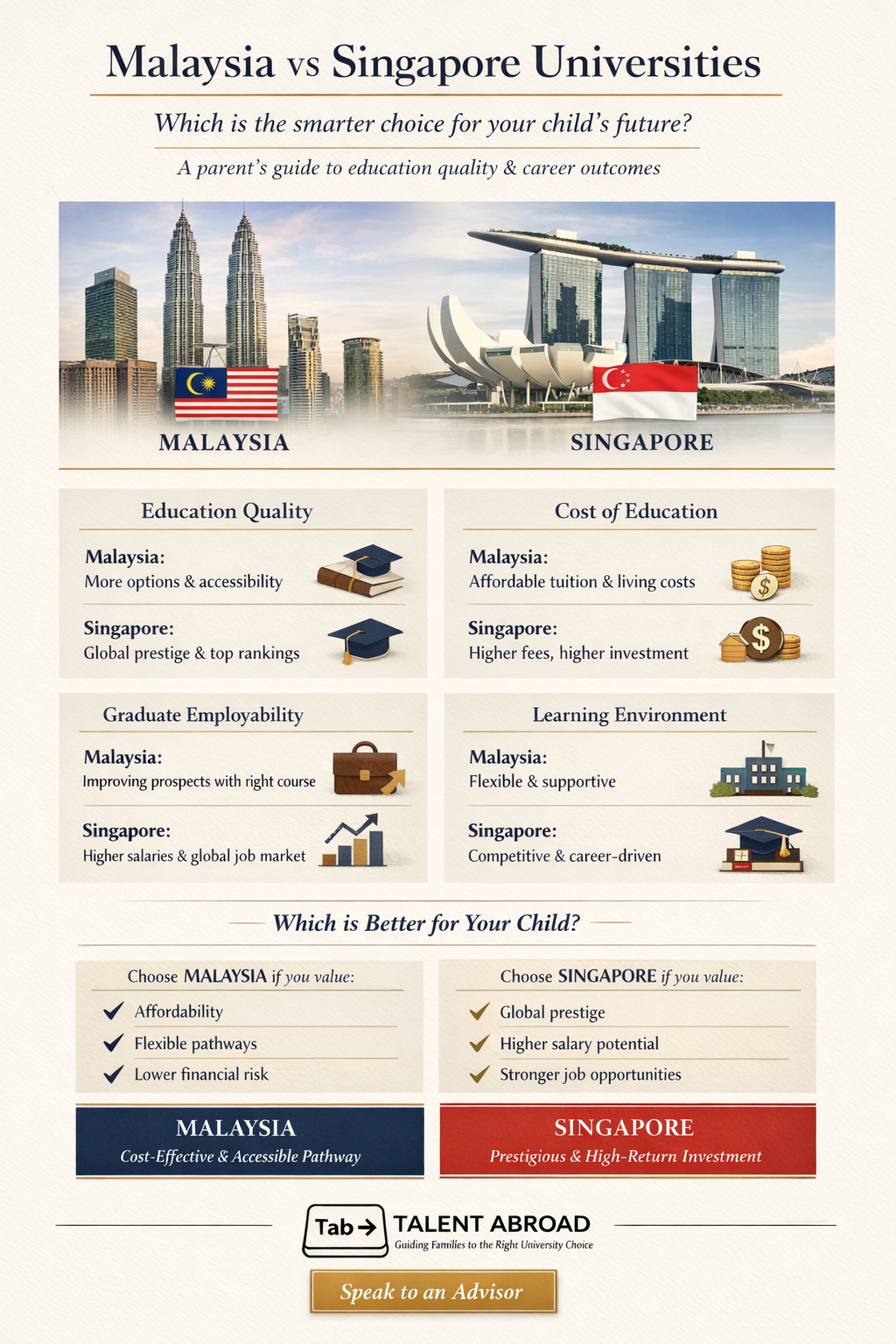
For many ASEAN students and parents, Malaysia and Singapore are two of the most practical study destinations in the region. Both offer internationally recognised degrees, English-medium instruction, multicultural environments, and proximity to home.
When it comes to university quality, affordability, employability, and long-term career opportunities, the two countries can lead students down very different paths.
The answer depends on your budget, career goals, academic ambitions, and where you want to work after graduation.
1) University Reputation: Singapore Leads, Malaysia Offers Breadth
If global rankings matter, Singapore clearly has the edge.
In the QS World University Rankings 2026, the National University of Singapore (NUS) ranked 8th globally, while Nanyang Technological University (NTU) ranked 12th globally, placing both among the world’s elite universities.
Malaysia, meanwhile, has a broader and more affordable higher education ecosystem. It is home to strong public universities such as:
University of Malaya (UM)
Universiti Putra Malaysia (UPM)
Universiti Kebangsaan Malaysia (UKM)
Universiti Sains Malaysia (USM)
Malaysia also stands out for its large number of private universities and international branch campuses, which give students more flexibility in price points, programme styles, and transfer options.
Choose Singapore if you want top global prestige and stronger international brand recognition
Choose Malaysia if you want more options at a lower cost
2) Cost of Studying: Malaysia Is Much More Affordable
For many families, Malaysia offers one of the best value-for-money university pathways in Asia. Tuition fees and living expenses are generally far lower than in Singapore, especially for students pursuing private university or foundation-to-degree routes.
Typical cost comparison:
| Singapore | Malaysia |
|---|---|
| • Higher tuition fees, especially for international students | • Lower tuition fees across many public and private universities |
| • More expensive accommodation, transport, and daily expenses | • More affordable housing and student lifestyle costs |
| • Stronger competition for scholarships and subsidies | • Easier access to budget-friendly campus life |
For students who want an overseas degree experience without paying premium prices, Malaysia often wins on affordability.
Malaysia wins on cost
Singapore wins on brand value and return per graduate salary
3) Teaching Style and Learning Environment
Both countries offer English-medium higher education, but the learning environments are often quite different.
| Singapore Universities | Malaysia Universities |
|---|---|
| • Highly competitive admissions | • More flexible entry pathways |
| • Strong academic rigour | • Wider range of student profiles and academic routes |
| • Greater emphasis on research, innovation, and industry relevance | • More accessible private education options |
| • Stronger links to multinational companies and advanced sectors | • A comfortable transition for many ASEAN students |
Singapore may feel more intense and performance-driven, while Malaysia can feel more accessible and flexible — especially for students who need alternative progression routes.
Singapore suits high-performing, career-focused students
Malaysia suits students seeking flexibility, affordability, and wider pathway options
4) Graduate Employability: Singapore Has Stronger Outcomes
Singapore graduate outcomes are stronger and more transparent.
Singapore publishes formal graduate employment outcomes through the Joint Autonomous Universities Graduate Employment Survey (JAUGES).
According to official 2024 survey results, 87.1% of recent university graduates in the labour force secured employment within six months, and the median gross monthly salary for full-time permanent employment was S$4,500.
Recent 2025 results continued to show relatively resilient outcomes despite a softer labour market, with 88.9% of graduates in the labour force employed and median pay holding at S$4,500.
That said, even Singapore is no longer a “guaranteed easy job market.” Community discussions on show growing concern among fresh graduates about tougher competition, slower hiring, and longer job searches — especially for generalist degrees.
Malaysia’s graduate market is more mixed
Malaysia’s graduate labour market is improving, but the outcomes are less consistently strong across sectors.
Official Graduate Statistics 2024 from the Department of Statistics Malaysia reported that the graduate unemployment rate declined to 3.2%, showing improvement in the broader labour market. However, this national-level figure does not necessarily mean all graduates are entering high-paying or degree-matched jobs.
In practice, graduate outcomes in Malaysia vary significantly depending on:
University reputation
Course choice
Internship exposure
English fluency
Whether the student studies in a high-demand field
Online community discussions in Malaysia also reflect concerns about underemployment, lower starting salaries in some fields, and limited openings in specialised sectors such as science and research.
Singapore offers stronger early-career outcomes overall
Malaysia can still lead to good careers, but students must choose their course and university more strategically
5) Best Degrees for Job Prospects in Both Countries
Degrees that tend to be popular/performing better in both Malaysia and Singapore:
Computer Science / Software Engineering
Data Analytics / AI / Cybersecurity
Business / Finance / Accounting
Engineering
Supply Chain / Logistics
Healthcare / Allied Health
Education / Early Childhood (especially in Singapore demand areas)
Social Work and applied public service roles
Degrees that may require more planning:
Pure sciences
General arts and humanities
Media and communication
Some niche design or creative programmes
This does not mean students should avoid passion-driven degrees — but they should pair them with:
internships
industry certifications
portfolio building
language skills
employability planning
A “good university” alone is no longer enough.
6) Can International Students Stay and Work After Graduation?
Singapore offers stronger corporate exposure and higher-paying opportunities, especially in sectors like:
finance
technology
logistics
consulting
engineering
healthcare
However, it is also a competitive job market, and international graduates still need employers willing to hire and sponsor them.
Malaysia can be easier and more affordable to study in, but students should be realistic about salary levels and post-study work pathways.
This matters especially for international students who hope to remain after graduation. Community discussions in Malaysia increasingly highlight concerns that entry-level salaries may not always align with future work pass thresholds or international graduate expectations.
Singapore offers a stronger career upside
Malaysia offers easier study access, but students should plan their career path early
7) Which Country Is Better for ASEAN Students?
| Choose Singapore if you want: | Choose Malaysia if you want: |
|---|---|
| • A globally prestigious university brand | • Lower tuition and living costs |
| • Stronger graduate salary potential | • More flexible admissions and pathways |
| • Better access to multinational employers | • A wider range of universities and private options |
| • A more competitive, career-driven academic environment | • A lower-risk financial decision for the family |
| • Stronger international mobility after graduation | • A comfortable and familiar ASEAN study environment |
Malaysia vs Singapore Universities
There is no one-size-fits-all winner.
If your priorities are global recognition, salary potential, and employability, Singapore is generally the stronger option.
If your priorities are affordability, accessibility, and flexible educational pathways, Malaysia may offer better overall value.
The smartest choice is not simply choosing the “better country” — it is choosing the right university and course for the student’s long-term career path.
In today’s market, success depends not only on where you study but also on what you study, how you build your experience, and where you want to work after graduation.
You Might Also be Interested in…
University selection based on ROI
Financial planning guidance
Scholarship positioning
Visa & relocation support
At Talent Abroad, we help students and families compare universities across Singapore, Malaysia, China, Australia, and beyond — based on:
budget
rankings
employability
scholarships
visa pathways
career outcomes
Talk to us today to find the best-fit university for your goals.
